“It would be opportunistic if I said either, I told you so, or, basically, you can now tell that [cities] are actually really dangerous environments to live in,” adding, “I think that it’s simply slightly reinforcing the argument that it’s incredibly important to begin to look not necessarily away from cities but at the neglect of the countryside.” – RK
“Derive of the UN_URBAN” is a reaction to AMO’s and RK’s unfortunately short-lived exhibition “Countryside, The Future” at the Guggenheim museum in February of 2020. The exhibit and subsequent research started upon the UN’s announcement in 2007 that stated 50% of mankind already lived in cities and that this percentage would increase to 70% by 2050. This indicates heading towards an outcome where majority of the population would live on 2% of the earth’s surface and the remaining 98% would be occupied by less than 1/5th of humanity. (RK, Ignored Realm).
This studio will begin to approach the complex topic of the ‘countryside,’ a word that creates a polarizing discourse between attempts to keep “as is” and to change “everything” (RK, Ignored Realm). It is important to understand that this studio is not searching for answers or to make a declaration about the countryside. Instead, we are attempting to contribute to the conversation by creating new situations which allow for culturally and socioeconomically encompassing complex discussions. To accomplish this the studio will be working in a speculative realm to avoid “countrysiding,” a term that manufactures small-mindedness, bigotry, tribalism, parochialism, nostalgia, and other smears placed on the rural areas as if they do not apply to both urban and rural. (Along for the Ride, Troy Conrad Therrien)
The studio will be working in groups of two with three main project milestones: site discovery and analysis, precedents research, and Trading Post project all of which are explained in further detail below. While the studio is set in the speculative realm, there will be heavy emphasis on fundamental architectural building elements and how they can be used in tandem with programmatic adjacencies to influence volume and space to create new experiences for the occupant. As a studio will work to refine your skills of traditional architectural drawings while exploring alternative representation styles including using video as a medium of representation and exploring architectural space for the final project.
All work is by students.
Instructors: Adam Wiese and Nate Gieselman
Sound Design Lab
By: Brandy Nguyen
The Site
This landscape of rolling hills and valleys is hot, arid and constantly buffeted by an eastbound wind. A river flows north to south, and it is along this more fruitful path that pilgrims partake in spiritual journeys of harvest, hunting, and fishing, making sure along the way to honor their ancestors, their land, and their food.
Along the journey, one encounters many great monuments of unknown provenance, sprouting from the earth like mutations. They all represent spiritual reverence to one thing or the other. This is the story of the first two:
The Colonnade is a series of sixteen solid posts jutting forth from the northwest bedrock. They flank a hiking path in two rows of eight. They are all identical in form, except for their heights. They are of rusted metal. Like ancient flutes—the first instrument created by man—each post is hollowed through its tip by a barrel-shaped tunnel. When the wind blows through them, the sixteen posts of varying heights vibrate a mysterious harmony. In this landscape, this is the inspiration and birthplace of music.
Across the bridge is The Ossuary: a series of twenty barrel-vaulted tunnels, bored along two levels within a massive limestone block. The upper row comprises ten tunnels of equal height. These inaccessible, pristine volumes are used to hold the bodies of the dead so that they can sing in the afterlife in equal stature.
The lower row comprises ten tunnels which are unequal. Their height conforms to the topography of the uneven, muddy earth, and their volumes have been eroded by water and grazing bison. This is the realm of the mortal. Here, the pilgrims honor their ancestors above through music, conforming their manmade songs to the chaotic concavities and convexities of nature.
The Project
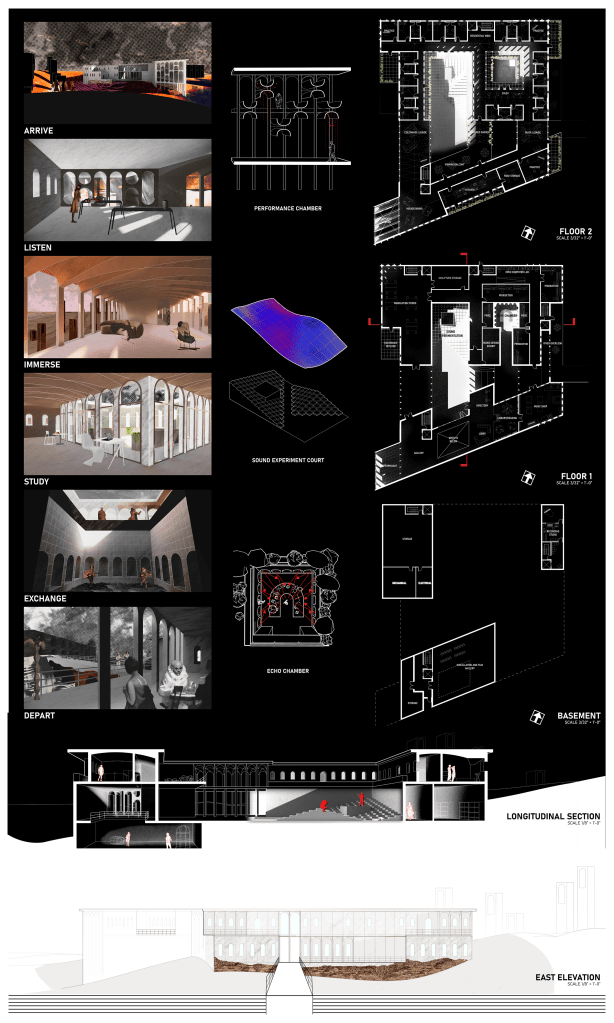
The Sound Design Lab sits between the two monuments. It is, ostensibly, a residency for communal living and exchange between musicians and other sound artists. Like the pilgrims before, they too honor the landscape through music, though the Lab prepares their musical pilgrimage with the tools, techniques, and scientific rigor of the modern day.
It is a courtyard building, providing an “eye of the storm” (both a refuge and a focal point) of sonic chaos. Its diagonal, southern wing follows the path of three other monuments which honor animals and their migration. As a result, the building has a tapered hallway, funneling both people and sound on their eastbound journey from wild, to open, to focused sound.
Two courtyards punctuate the building, one large, one small. The first is wide and expansive and acts as a wholly public space for performance. The second is small and set off the main path: a more intimate and echoic space.
On the second story, a series of walkways connect the north and south wings of the building in an “E” shape. Their axis emphasizes the pathway. Garden spaces permeate the entire second floor.
The building is an exercise in the geometric principles of convexity and concavity. Put simply: convex shapes spread and diffuse sound waves, while concave shapes reflect and focus them. The convex edges of tapered arches create the building’s armor, shielding it from the chaotic outside in its most sensitive spaces—those which hold production and performance spaces.
Meanwhile, the residential second floor consists of ceilings which are entirely concave with either barrel or groin vaults, following a rigid module. For the inhabitants, these spaces bounce their sound, either to themselves (in private bedrooms) or to each other, in the hallways. Moreover, the pervasive language of convex and concave shapes surrounds the inhabitant in the musical language of the natural landscape, forcing them to learn it by immersion.
The Program
The first floor is split between north and south wings.
The north wing of the ground floor is productive. It holds a fabrication space for sound sculpture with wide access galleries to both a small sound design exhibit and a larger gallery space. Further east are smaller production rooms, holding auditory equipment such as synthesizers. Either end of this north wing has access to a patio, overlooking either of the two monuments. Basement access to fabrication storage and a recording studio are available from this wing.
The south wing is public gallery space. A retractable folding wall brings viewers inside an atrium space. Here, they are led to the third performance space: a double-height interior gallery, punctuated by barrels both concave and convex. The reflecting nature of concave forms and the diffusing nature of convex forms turns this room into a giant pachinko machine, but for sound waves. It is an experiment in the effect of echoes in the vertical axis.
Outside, the largest courtyard and performance space impresses the west side of the building with an abstraction of the very landscape it sits on. Square concrete steps imitate the natural curvature of the bedrock, the hills, the river, but in modular form. This is the sound experiment court. For amateur musicians, this is a place for play. But as sound engineers, they’ll learn to adapt to idiosyncrasies in the soundscape.
“If you stood on block E3 and sang, would it sound better if I were listening on B5 or B6?”
The second floor is also split into north and south wings. The north wing is residential. Each living unit is located near one of two practice rooms and one of two balcony rings. The first ring surrounds the large courtyard. The second smaller ring surrounds the last performance space: the Echo Chamber. In a building designed for sixteen residents, the echo chamber contains fifteen niches arranged around a parabola pool. Though designed for a central speaker in the parabola’s focus, the space can be used in any configuration to test the effect of echoes in the XY plane.
The south wing holds communal functions, including a larger group practice room and a kitchen. The kitchen garden overlooks a small pool, hosting an oasis of animals grazing. The indoor and outdoor dining areas overlook their adjacent performing areas.
The north and south wings are connected by glass-encased lounges. A continuous sightline extends across the building here, acting as a constant reminder of the ultimate path from west to east.

untitled
By: Kael Jakub
Site Narrative
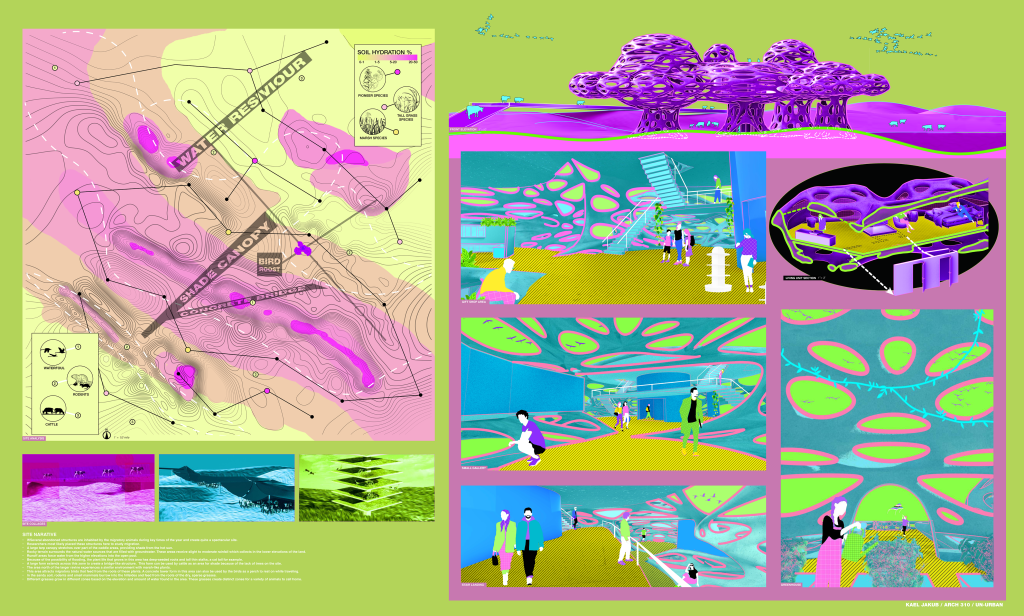
The mild weather changes create an ideal landscape for migratory animals to travel to, but the dryer climate limits the natural farming that can be done in the area. The plant life is also limited by the sandy soil that is found in the southern section. A large tarp canopy stretches over part of the cattle areas, providing shade from the hot sun. Rocky terrain surrounds the natural water sources that are filled with groundwater. This area receives slight to moderate rainfall which collects in the lower elevations of the land. Runoff areas force water from the higher elevations into the open pools Because of the possibility of flooding, the plant life that grows in this area has deep-seeded roots and tall thin stalks, a cat tail for example. A large form extends across this zone to create a bridge-like structure. This form can be used by cattle as an area for shade because of the lack of trees on the site. The area north of the larger ravine experiences a similar environment with marsh-like plants. This area attracts migratory birds that feed from the roots of these plants. A concrete tower form in this area can also be used by the birds as a perch to rest on while traveling. In the sandy soil, rodents and small mammals burrow into the hillsides and feed from the roots of the dry, sparse grasses. Different grasses grow in different zones based on the elevation and amount of water found in the area. These grasses create distinct zones for a variety of animals to call home.
Project
Three structures were erected on a rural site by researchers long ago to help observe the immense migrational gatherings that happened on the site. These structures were more-or-less abandoned so the animals could continue to use and occupy the structures for years to come. The structures, animals, and land are all at risk of being harmed by global warming and poaching so the researchers need to come back and attend to the area. Avoiding unwanted visitors exploring the site and trying to view these migrational patterns on their own and turning it into a safe and fun experience is also a goal of the building. The building uses materials that are taken directly from the site, that way the building can hopefully degrade naturally back into the earth. Cattail fibers harvested from the site help reinforce the concrete that the building is made from, much like fiber glass. Seeds, clay and limestone are also added. The seeds can hopefully introduce endangered plants back into the biosphere and supply food for birds and animals. Once the concrete is mixed it could be sent through a 3D printing system allowing the building to be built from the ground up with minimal effort. Minimal prefabrication would be needed, and can be easily disassembled, as the floor units will hopefully bring the structure to a collapse, whenever that is to be determined. The building would hopefully collect rainwater and store it much like a water tower and help irrigate its own crops in the greenhouse for continued self-sufficiency. Once the researchers had successfully obtained the research they needed or possibly found a place for users to experience better views the building could be safely collapsed and the cycle could continue, leaving the area better than before.
Program
The program is laid out with three central pod-like structures that connect to one central hub. The program itself is lifted mostly off the ground, as to not interfere with the animal migration pathways, and allowing the guests to get close views of these paths. To enter the building, you approach from the bottom and enter through a small containing entrance that opens you up to a larger more inviting space with immense views. As you enter the central pod from the elevator or stairs, you are circulated through the central core that guides you to the gift shop or other gallery spaces that branch to other spaces. The living program consists of a large pod situated closest to the site context. This living pod contains kitchen and living and has intriguing views. Small sleeping unit pods that have their own personal bathroom extend around the living pod. Each bedroom summarizes the experience of the whole building but on a personal user-based level. Public restrooms are left in their own pod along the exterior of the building, offering interesting views not usually seen in restrooms. The user then must exit to the outside of the building onto the roof to enter the large outdoor gathering space. This forced exit to see the rest of the building makes the user see some intriguing views. This space has a greenhouse and living room off it for continued living interactions. The greenhouse receives maximal light and is large for farming on the top of the building.

“Frame”ing Observation
By: Haley Herman
SITE NARRATIVE.
The site is moderately flat but has areas of steep plateaus and ridges. Little to no rainfall is experienced on the site which causes the vegetation to be mostly tall prairie grasses. Trees are not able to root in the sandy soil, so the site is not naturally shaded. There is a large series of canopies that is able to provide shade for the animals that are naturally present on the site.
There are areas where the canopies have begun to rip and shred apart but they are mostly intact. The cattle collect under the canopy to hide from the harsh summer sun. The water that is present rises from the aquafor below. The groundwater pools allow for marsh plants to grow which attracts migratory birds into the area. One of the structures that was discovered on the site is a tall tower that has been taken over by the birds and is now a nesting ground they return to each year. The land experiences seasonal changes which causes the birds to spend only a few months of the year in this area. The birds fly into the site during the spring and fall months. The birds come into the area and collect on the resting tower. Surrounding the tower are higher rising plateaus that the birds travel around. The plateaued areas are rocky around the ridge lines but tall grasses grow on the flat tops. The selected building zone on the site is on a raised plateau near the east end of the land. Travelers can only access this zone by coming from the east where the elevation remains similar before dropping off at the end of the plateaus.
PROGRAM NARRATIVE
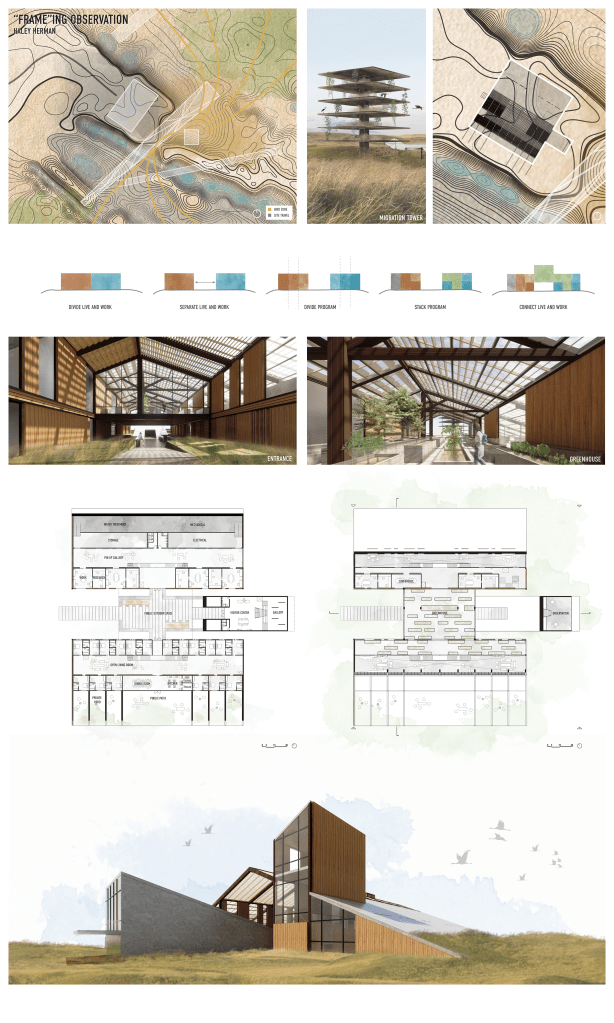
The outpost is serving as a research facility that is based around the presence of the migratory birds. Research is done on both the migration patterns as well as the marsh plants that draw the birds into the area. Six researchers live and work full time in the outpost and 12 college students are invited to study under the researchers for one month at a time. During their month of research, the students are given the opportunity to focus on different aspects of research and sustainability efforts. Two students will work with one researcher at a time therefore each research space is directly connected to one collaborative work space. Outside of each of the workspaces is a large corridor pin-up gallery for students to present their work to one another and to other researchers. On the upper floor, there is a large conference space adjacent to the connecting greenhouse space. Also in the work side of the building there is space for water treatment machines. The machines can pump water from below ground to sustain the building. On the live side of the building, the bedrooms are separated by a long, open living space that promotes collaboration and communication between students and researchers. The researchers have access to private patio spaces and a large public patio sits outside of the kitchen and dining spaces. The visitor center houses an observation deck for visitors to utilize and a gallery space for the students to showcase their work. There are also two observation towers that rise up from the building to allow the researchers to take in views of the migration tower from just about anywhere in the building. The observation tower in the living side of the building is primarily used as a hang out space while the tower in work side would be used for observation and photography.
BUILDING NARRATIVE
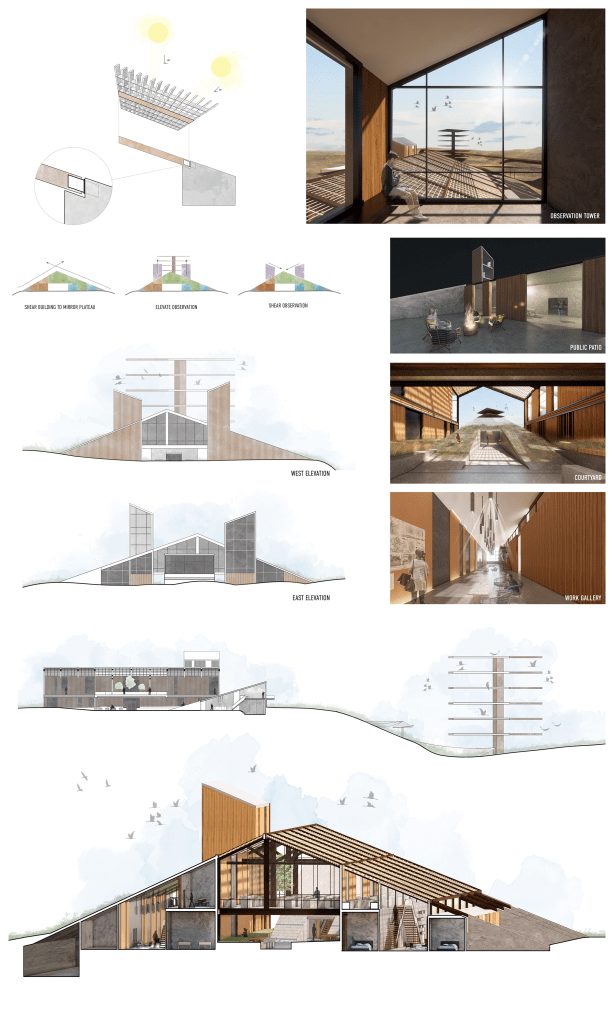
The building is situated between two natural pools of water, so it can be easily pumped into the facility. Also, it is situated atop the elevated plateau providing easy viewing to the migration tower and land below. The building itself was constructed through a series of driving factors. One being the want to separate the live and work environments. After the space was divided a connection space was added which serves as the greenhouse space because both
the work and live spaces will utilize the greenhouse. The building was sheared into an A-frame to reflect the geometry of the plateau that the building is sitting on. The observation towers are sheared in the opposite direction to meet the angles of the A-frame roof structure. The space below the greenhouse creates the entrance to the A-frame building as well as the visitor center. The entrance space opens into a courtyard that is sunken into the ground. This both lowers the overall profile of the building but also creates a more immersive experience as one enters the building. After entering the building, the researchers and students can travel through the greenhouse space on the second level to move between the work and live sides of the structure. The roof above the greenhouse and outdoor space has been replaced by glass and a wooden pergola. The pergola is constructed of wooden beams that are situated at a certain angle that allows low winter sunlight to enter while preventing high summer sunlight from overheating the space. Directly over the greenhouse space there are less wooden slats to allow the space to gain more solar heat in order to create the best growing environment. The wooden element carries into the facade of the building. Around the exterior, wooden beams are placed vertically and subtracted to create window openings. Horizontal beams run across the facade to break up the vertical panels and create a natural break. The visitor center uses the same angled language from the A-frame but simplifies into just a wedge shape. Visitors walk through a cut of the wedge and enter into a dark space with glass framing the migration tower in the distance.
Observation Outpost
By: Lauren Castaneda
Site Narrative
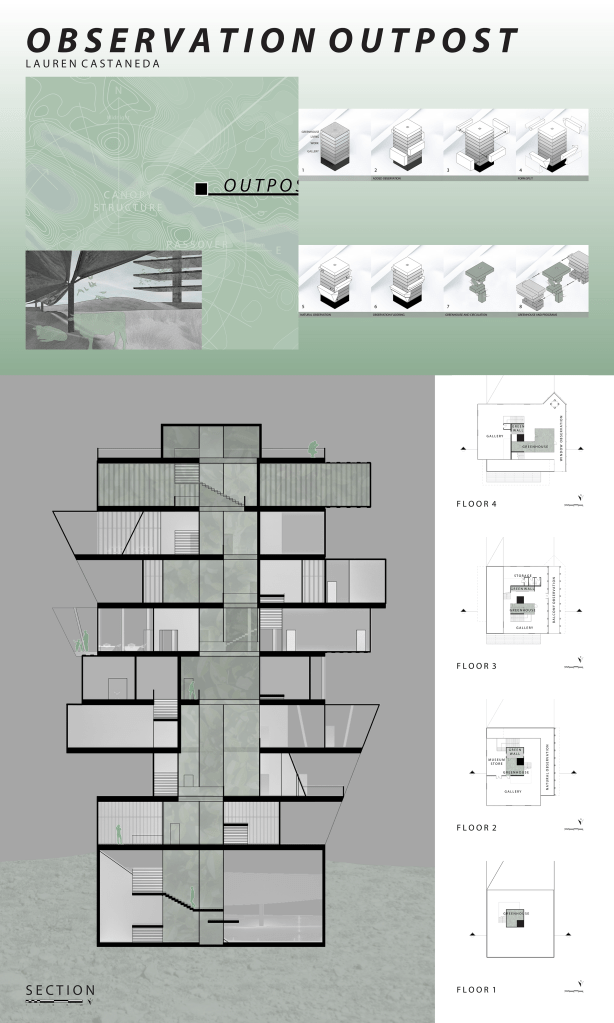
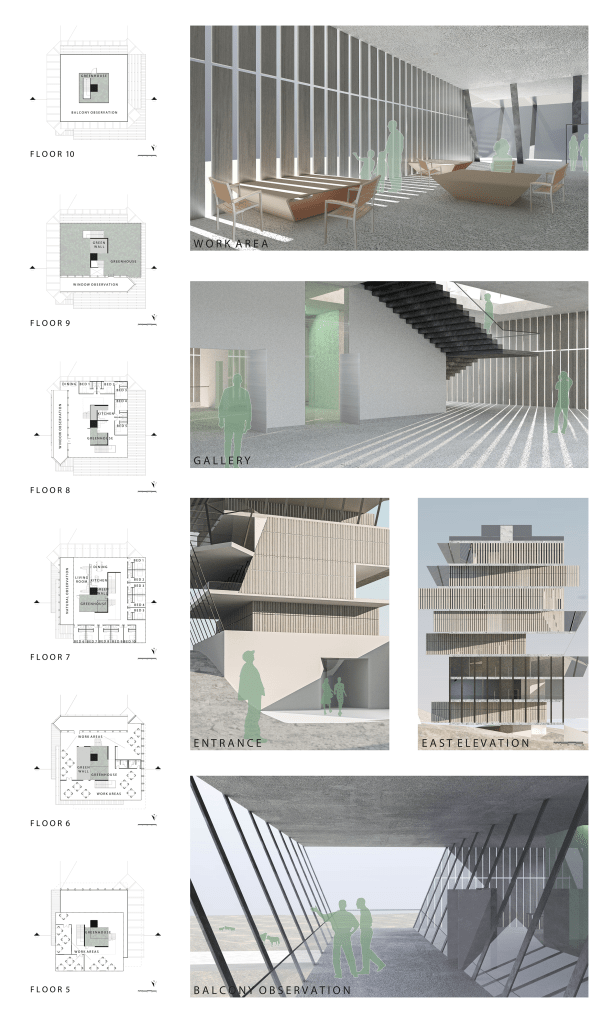
With seasonal qualities and a rural setting, this area consists of tall native grasses and sandy lands with few changes in elevation. It isn’t the best for farming’s sake because of the ground’s sandy texture but it is still a home for many. Majority of the animals that inhabit this area are cattle, birds, and coyotes. A marsh runs through the middle flowing alongside the small hills. A research group was of interest in the Native qualities this land has and how these birds can adapt during their migration. 50 years ago this group of researchers placed four man-made forms in this out-of-context area so that people can observe the qualities and how the surrounding environment and animals have adapted. Three of those four man-made forms were of main focus with one being the actual foundation for the now observation outpost. The reason this location was chosen to add on to this existing, now over time has adapted into a “bird tower” structure. This location has great views nearby of the canopy structure, animal Passover, and is engulfed with the birds. With the original tower structure being so tall there was also opportunity to have views across the whole topography, the fourth water irrigation form and beyond with floors on each level. Being it may seem as a disruption for the birds, they migrate seasonally for the building construction’s sake and this whole concept is to take these valuable observations and research opportunities and move them towards ways we can improve on future habitats and untouched and built environments through this parasitical architectural movement.
Program Narrative
With my outpost being front and center with the surroundings it was important how I arranged my programs. First looking at how I arranged the observation balconies and the relation that has with the user’s experience as they make their way up the tower. There is observation on every floor that shares the same “chunks” between programs. I wanted these balconies to be areas for anyone and to be accessible as one is making their way up, even if they are on the floor where the researchers live. My main gallery spaces stretch across the first 3 floors in my outpost, not including the first floor for entry. The next two for work spaces, next two for living, and the following for a full level greenhouse then 360 degree observation balcony on the top. The gallery spaces are very open spaces for the researchers to hang their discoveries, local artist’s work, really anything to give someone information about the surrounding nature. The work space areas aren’t reserved for anyone specific making these areas great for collaboration and conversation, or just for a monthly visitor or researcher to take a break with a view. Floors seven and eight are designated for the five researchers who live in the outpost year around and then the visiting 10 who come every month. Along with my observation stops to keep the visitor moving up my building are the glimpses of green they see as they move around corners from the greenhouse lighting. The greenhouse gives a relation to all the programs the moment you take a break from one of the gallery exhibitions to look at the greenery being grown in the greenhouse and seeing a researcher in their element on an upper story.
Project Narrative
When I think of my project narrative as a whole I think of the question why? What is my hope to discover or learn from this structure? I think that today in our society we become so normal with our every days moves in the built environment and there is much to come in our
future. My generation specifically is going to hopefully be seeing many changes towards a more sustainable way of living and being open to the idea of making a difference. This comes with research, bringing greenery into our everyday lives, being conscious of the natural environment around us, and the want to have a longer lasting world for generations to come. This idea of placing a building in such a rural area seems quite the opposite but it isn’t the idea of disrupting the animals and birds specifically but to live with, study, and spread the learnings from the outpost for the population to learn about. As more animals start to become extinct it is important to know the reasoning behind and to at least be conscious of our decisions in life.
HLX Museum of Mining
By: Hayden Rech
Site Narrative
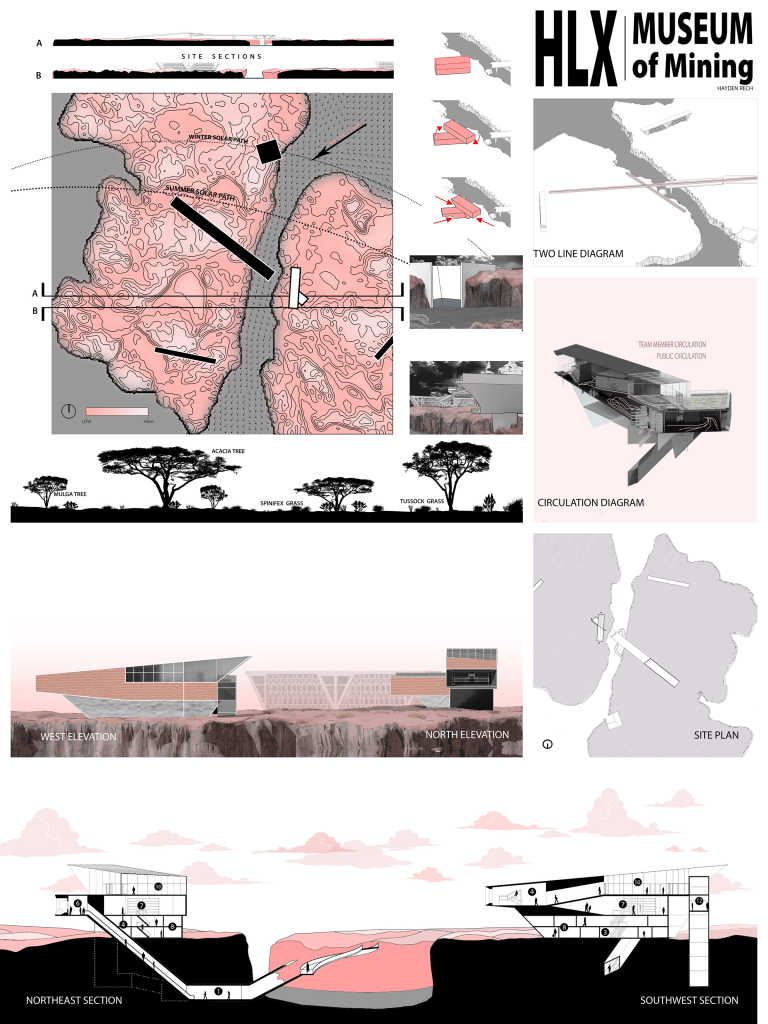
This site was created throughout the beginning stages of our semester. We initially took pictures of our natural and built environment and then combined one image with a partner. The resultant of my image was an amalgamation of dark and light spots, which were interpreted as two large land masses that are surrounded by water. The site is located in the Southern Hemisphere so the solar paths are quite a bit different than what we’re used to. The land masses, or peninsulas, are surrounded by harsh cliff edges. The distance down to the water from the mainland is about 40 feet. There is an ocean located on the western side of the site, but there is also a river that flows freshwater in between the landmasses. The freshwater is able to be collected and utilized for my building. The climate on this site is very similar to that of a coastal desert. It is very dry and semi-arid. There is little rainfall received in this area. There is sporadic vegetation all throughout the site. The vegetation consists of a variety of dry-climate trees, shrubs, and grasses. The soil is dry and sandy. The site itself was once the location of a thriving mining community. The miners and occupants that lived and worked here ran out of natural resources to collect and fled the land. The miners left a variety of structures from their operations, which have since become ruins and obstructions to the site since many years have elapsed since their disappearance.
Project Narrative
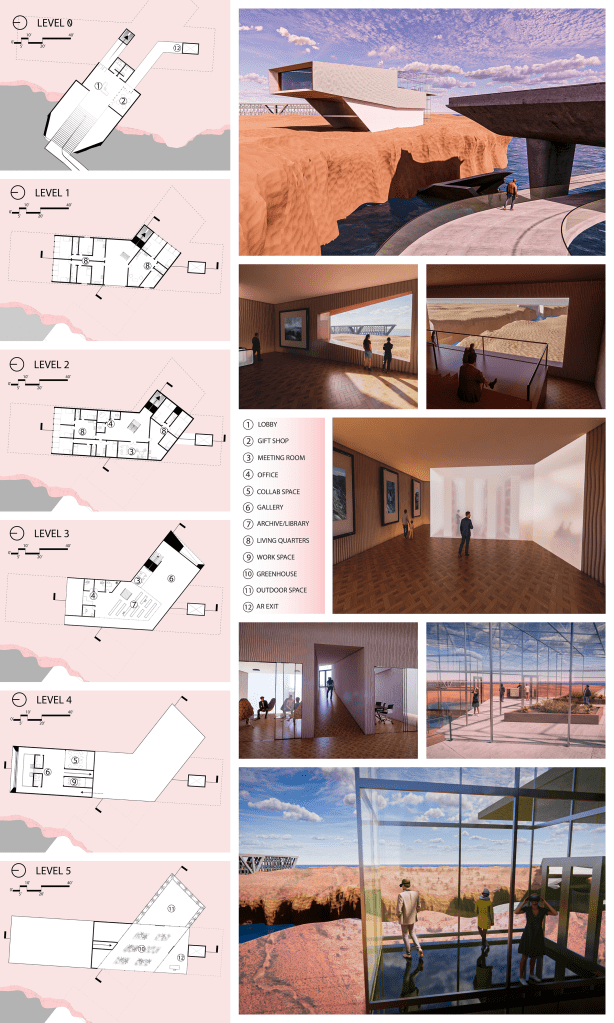
Since my building is a museum that is all about the historical events that took place on this site, I wanted to tell that history in a linear fashion. I accentuate this idea by the emphasis on circulation. The circulation would bring the visitor through an entire story of the site from beginning, present, and future. I also emphasize the story through the use of lighting that is allowed to enter in each zone throughout the museum. The visitor will begin the experience by diving into the ground plane and be immersed in the carving away that typically happens within the mining process. The lobby and entrance are designed to feel dark and alarming. They will then take the circulation path up to the first landing gallery of the museum. Here the guest is given a smaller aperture that looks out to one of the abandoned structures that is left on the site. At this moment in the visit, they will feel sorrowful and intrigued. Next, there is a singular path that takes the guest to the next aperture which is a very large glass window with a viewing area. The visitor will truly feel the immense gravity of the damage that has occurred on the site as they glance out at any form that has carved away at the cliff’s edge. After this stop along the tour, the guest will continue up to the outdoor area of the museum. There is a large greenhouse which educates the public on the ways in which this site can be brought back to it’s former state, before the mining community caused all of the damage. Finally, there is just a singular glass elevator that will take the guests back underground to their starting destination. However, before they step foot on the elevator, they will be given an augmented reality headset for which to view the site through. As they descend down the elevator, the guests will have a panoramic view of the site that shows that what it could be like in the future if the landscape could truly be healed.
Program Narrative
For this semester’s project, we were given a list of programs in which to incorporate into our outpost. Even though we did have those defined regions, we were given the freedom to choose which type of building we wished to place on our site. The objective of this project was to design a sustainable outpost that housed quite a few team members who occupied this building. I elected to go with a museum. The museum will reflect the site context and represent the events that took place there. The building will be a historical museum that informs the public on the destructive processes of the museum and poses a potential solution in the end. We were challenged to find special relationships between the programmatic spaces and the building itself. I decided to focus primarily on the circulation of my museum. The circulation in any building connects all the different rooms together, but I would use circulation to define a very specific path and experience throughout my museum. I first used circulation to enter my building, taking the bridge across the river and diving into the earth’s surface. The visitor is then forced to take a singular path through each portion of the museum. Beginning with the escalator into the first gallery, and continuing with the undulating ramps found on the interior. The visitor would receive an intentional and meaningful experience and they follow their route. The circulation is also extremely important for the team members who are housed here, as it gives them their own private spaces without being interrupted by the public.
untitled
By: Trent Weatherwax
SITE NARRATIVE
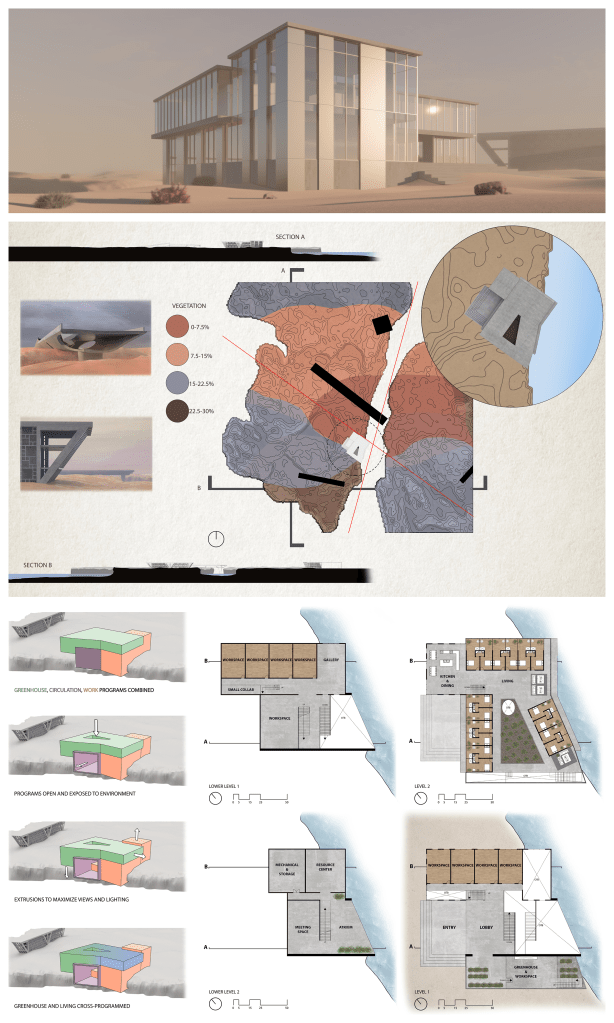
The year is 2050, and climate change and a lack of resources has created a world completely different from our own. This site is located in a now desert-like climate that has been ravaged by past inhabitants. The site was home to a mining community around 50 years ago that continuously dumped oil into the river, which effectively ruined all plant life in the area. All these years later and the site is still largely unable to produce any vegetation compared to what it used to. One day, when resources had run out, the mining community abandoned the site, leaving almost everything behind. Now, structures are sinking into the ground and breaking apart. Two of the forms in this site are believed to be old housing centers. Additionally, there is a collapsed bridge and a hole near the edge of a cliff. What once was a beautiful site with plenty of greenery has now become a sad depiction of what life is currently like. With several plant species now going extinct every day, a group of scientists and world leaders have organized to create a pilot facility with the aim of genetically developing plants that are better suited against climate change and harsh environmental factors. This site specifically was chosen because it appears to be more harshly affected than most others. The goal is to genetically engineer plants that can survive in this environment, in the hopes that they would then be more likely to be able to survive in almost all other environments.
PROGRAM NARRATIVE
This building is entirely self sustainable. Water is pumped in from the river flowing through the site and is then filtered and purified for human consumption and plant consumption. Energy is produced from 5400 square feet of solar panels on the roof of the building.This building also utilizes two different methods for growing plants. In the lab, an aquaponic system delivers essential nitrites for plants. Plants gather nutrients from fish, while the fish keep the water clean and fresh without having to continuously add chemicals and waste water. In the greenhouse, compost is used. Plants grown for research are either eaten or thrown into the compost bin. The building has 16 residents at a given time who spend their time researching. For an isolated location like this, it is important to create a small community within the residents, this is why all of the three housing sections are facing each other. Each member also gets their own personal greenspace in their rooms. Members are often running around doing multiple jobs throughout the day and working together with different people. Because of this, the importance of communication between members is highly crucial for the success of this operation. Along with the meeting room, workspaces are designed to promote communication and collaboration between members. The building has a large open-air atrium that serves to connect all of the programs of the building together. Additionally, a gallery displaying the accomplishments of the researchers has been implemented to help keep researchers motivated.
PROJECT NARRATIVE
As a response to the poor site conditions and inability to produce food locally, a facility specializing in the genetic engineering of plants will help convert this wasteland into an again thriving community, along with sharing research with the rest of the world. The building has ten workspaces for the sixteen occupants. Of the ten workspaces, four of them are isolated and controlled grow rooms focusing on growing plants efficiently to help speed the research process (seen in section B). Additionally, four of the workspaces are dedicated to research. The research team takes the plants grown in the controlled grow rooms and when they are deemed successful, they are put to the test in the buildings’ own greenhouse. This greenhouse is way different from the average greenhouse because for one, it is in a harsh environment; secondly it is also open air. There is one small workspace in the greenhouse, for the member who has taken on the gardening role. The last workspace is a general workspace that has lab equipment for testing, but is set up to be a large demonstration room that can fit all of the occupants. The team’s goal is to bioengineer plants that make it at least feasible for people to move back into the area, and to also keep plant species alive. If successful, this team’s research could pioneer the way agriculture can continue given current global temperature trends and would additionally lead to more of these facilities popping up all over the world.

The Cube
By: Abby Mowbray
Site Narrative
The site is in a hot, semi-arid, desert climate. There are five natural aspects showcased throughout the site consisting of grasslands, desert/ drylands, plateau, bird sanctuary, and an animal serpentine. A majority of the site is above sea level, but there is a major river that flows east to west in the middle of the region.
First, we have the climate. The daytime temperature average in the summer months is between the upper 80s to 100 (F) and in the winter in the lower 60s (F). Nighttime temperatures in this desert can drop below freezing in the winter months. Average annual precipitation on this site ranges from 5 to 20 inches.
Next are the five natural aspects of the site. The grasslands can and do exist, in deserts like this. In locations where the clay-rich soil resists water drainage, it is typical for grasslands to dominate the area. Desert and drylands are contrasting to the grasslands for they are barren of water and consist of few plants such as succulents. The plateau is even more barren than the desert, with little to no life. The bird sanctuary is located within the grasslands and is a beautiful place to see bird migration and growth. And finally the serpentine, or more commonly known as animal track/ trail. This is a natural path animals in the region have created within the site and claimed as theirs.
And finally the land composition. Half of the land is desert or plateau and is primarily composed of beautiful Navajo Sandstone. This sandstone consists of orange and white rock intertwined with each other. The other half of the site, above sea level, is grasslands. The grasslands soil ranges from clay-rich to sandy soil depending on the location. The sandy soil is found closer to the waterways in the site. This is because below sea level the land becomes sandier from the deterioration of the surrounding sandstone.
Project Narrative
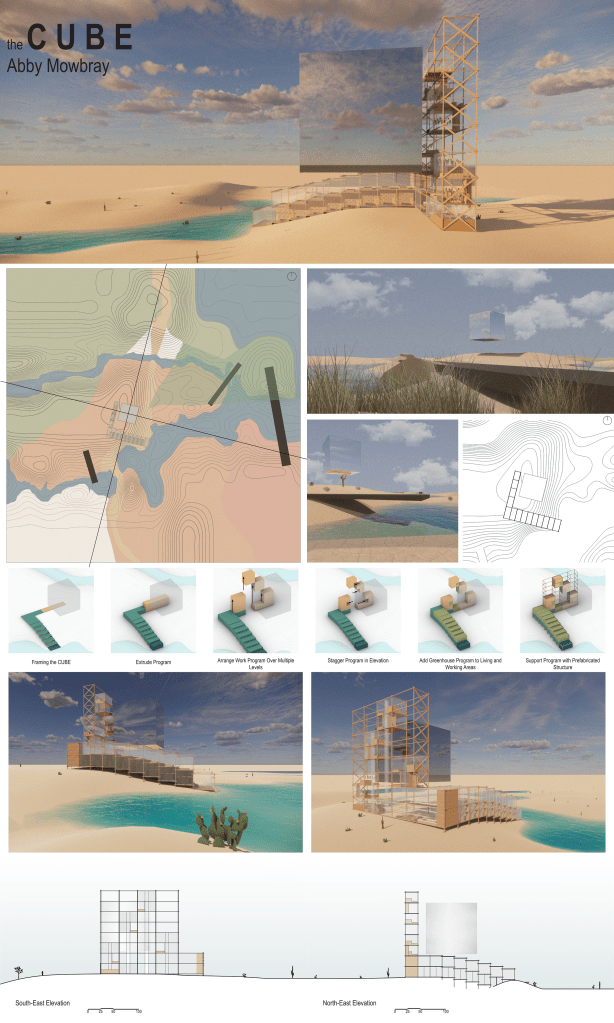
Not too long ago, a couple of scientists were floating down a not well-known river with the full intention of mapping out the river further. Along their travel down the river, they came across these massive interventions. Alongside the waterway, there were four unnatural and unexplainable forms. Three of these forms were rectangular and they lie on or impressed into the site, all across or next to the water. These forms are black with little reflectivity. The final form, the most interesting of them all, was a floating cube made of a mirrored material. The researchers were stunned and immediately had an interest in learning what was going on here.
As the core researchers studied these black, rectangular forms, they came up with a hypothesis. They predicted that long ago all the forms were floating above the earth with a mirrored surface. But, over time the forms started to fall, one by one. When a form falls and hits the surface of the earth it instantly loses its mirrored effect. This would explain the variation of impressions in each rectangular form. The far west form is partially buried underground from rock and sand movement over time, while the far east form has fresh cuts in the earth making it clear where it starts and ends. From this observation, the researchers predicted that the form furthest west was the first form to fall, while the eastmost form was the most recent because of its clear cuts into the earth’s surface. In addition, the depths of the forms can tell us how far off the ground they were floating before they fell. The furthest east rectangle was the highest floating because it is now the deepest impression on the site.
With all of these theories floating around the science community, there was a push to find out the most information possible before the final floating object came crashing to the ground. They decided to present this information to the public, and when they did the researchers’ interest became worldly. Because of this, they were able to raise enough money to build a research facility on the site. This facility would benefit the scientist and researchers with deep desires to want to know more and get some answers for this unexplainable phenomenon.
Program Narrative
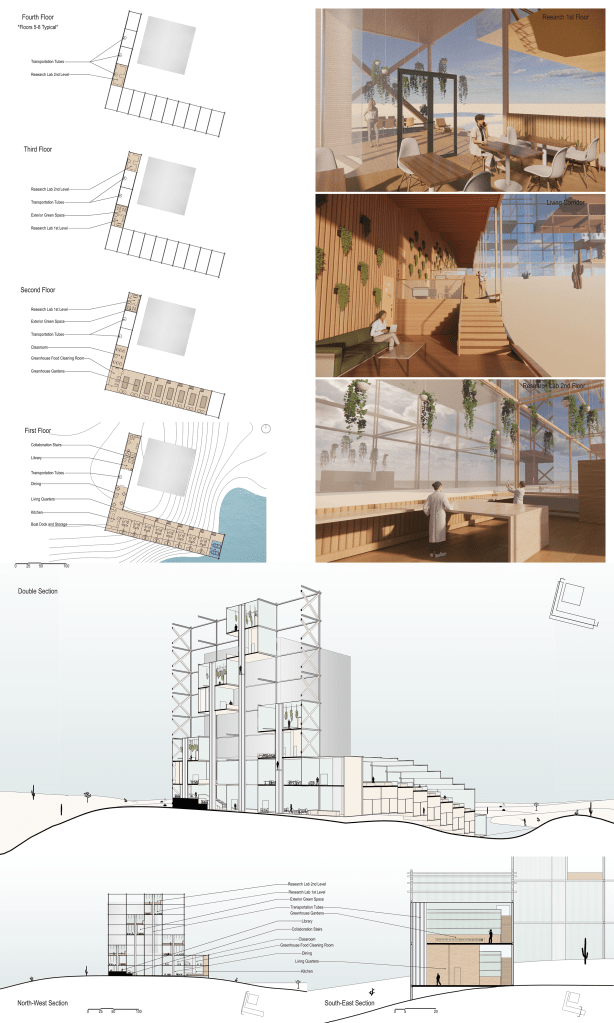
The building presented is designed to be a live-in research facility. Researchers come to live and work around these four unnatural interventions. Six core researchers will live in the building full time, and there is additional room for 10 traveling researchers to occupy the facility. The traveling researchers are invited by the core team and stay for only a few weeks or so. The focus of all four forms is the single floating object; the mirrored cube. It is the main attraction and the reason researchers come to this area. For this reason, I have placed an arrangement diagram, or a two-line diagram, to intersect in the center of the cube. I have also placed the program in an L shape to frame the Mirrored cube itself. Researchers journey to the site via the river, so the first program is boat storage and dock. From there the researcher’s journey continues up the hill through the living corridor; where individual living is to the south-west, and the corridor is north-east towards the cube. Once at the top of the hill there is a kitchen and dining space. The second floor of all the programs listed is greenhouses. An outdoor corridor separates the living program and the working program. Floors one through eight of the working program are scattered variations of meeting spaces, research labs, and outdoor green spaces. The program is laid out to make the people occupying the building always have a focus on this floating object. No matter where you are inside the building there will always be a viewport to the cube. The one location that does not have a view would be the bedrooms, but each sleeping space has a transportation tube to the rooftop greenhouses that have the best view of the object. This is important because the researchers are living here, dedicating their lives to this form so when it decides to fall everyone in the facility will be able to watch it.
THE PILGRIMAGE
By: Lubna Al Sebaie
Site Narrative
A landscape with two distinct biomes, being a mountain range and grassland. The western part is full of rocky terrain and soaring views. Never a dull moment in its elevation, with peaks and valleys along every curve. To balance this rocky terrain is the smoother grasslands to the east. Smooth and nourished with lakes, the land much more fertile, understanding and the main location for living activities. Inhabited once by humans, the only thing left of their legacy is their ruins. High in elevation in the mountain range, sits a monument dedicated to spiritual rituals. The temple was used for dedication and commemoration to their beliefs. Aligned in orientation, lays a ceremonial commemoration just west of the temple. This piece has been used for ceremonies like weddings, national celebrations, and formal events. Unlike its other two siblings, the third is a monolith facing the west, towards the mountain range. The monolith was intended as a sacrifice platform. Seemed to have been derived from the stone from the mountains, these pieces all have similar characteristics. Seeming to have very basic geometry makeup, they all consist of two: rectangles and arches, though each geometry is implemented in different parts of the pieces. Although it is a demolished ruin, the ancient kings’ ritual spa ruins lays in a unique place near the middle of all three monuments. This spa was used by kings to relax and replenish their physical, emotional and spiritual energy because they believed that the energy from all three monuments does interact at this point, thus transferring that energy to the kings.
Project Narrative
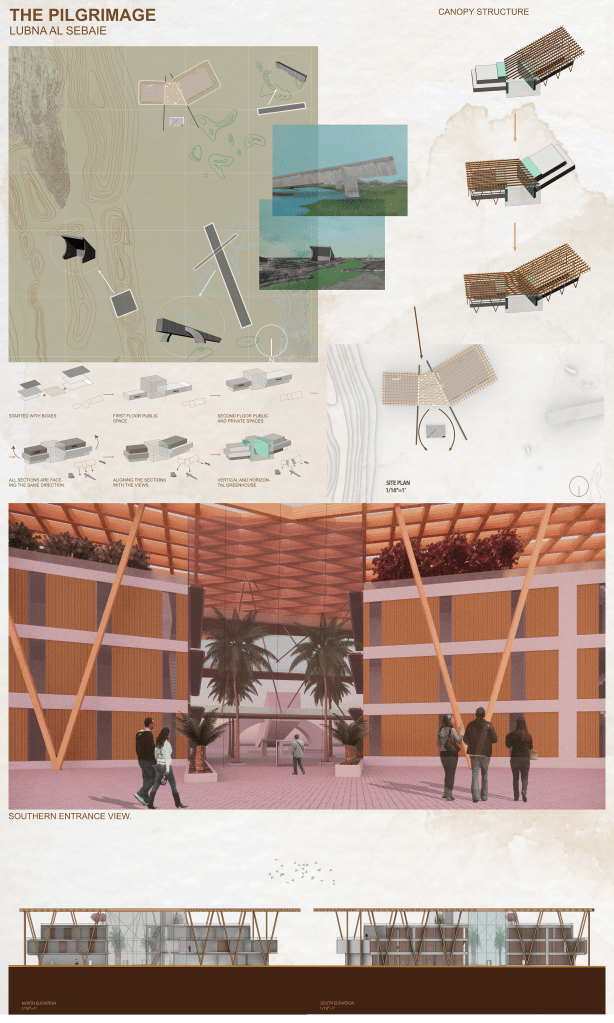
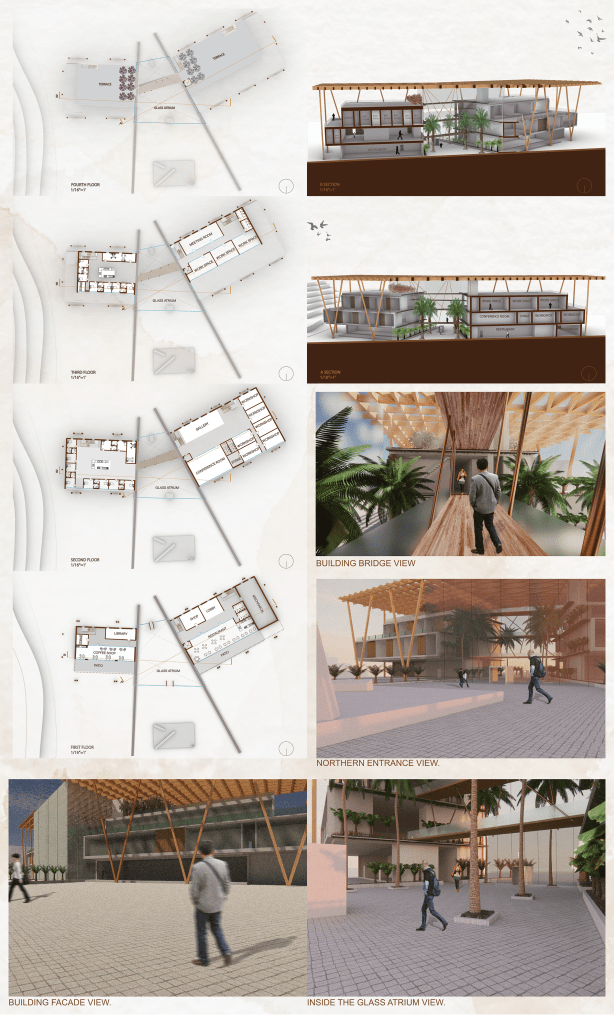
Starting with the eastern building of the visitor center is the main building. The first level contains the main lobby, information desk, a restaurant serving ancient food, and a shop that sells local products. The second level contains a large conference room that hosts historians and archeologists who conduct lectures and seminars about the site’s history and civilization. In addition, there are six workshop spaces for craft learning using the ancient civilization tools and a wide range of classes such a language, history, archeology, and other classes aimed to help travelers understand the old civilization and the site. The large gallery is also located on the second floor which displays found ruins ancient inscriptions and modern site art can be found there. The third level contains four large workspaces to allow employees of the center to conduct their daily job. It contains all the offices and meeting rooms. Finally, the fourth level contains a greenhouse and a large terrace. The western building is considered the secondary building. It also contains four levels. The first level contains the library, food storage room, and coffee shop. The second floor is the travelers’ living quarters. The third level contains the core living area for the staff. The two buildings are connected with a glass atrium. An atrium is an important place in my program where it connects two major buildings and sees the most traffic. It gives the first impression of the building and sets the start of the visitor’s journey inside the building. I chose to use natural materials in my atrium to allow it to be a continuous part of my site, nature uninterrupted. Based on my research, I found a few ideas on how to maintain an efficient glass atrium where it stays cool in the summer and warm in the winter without consuming extra energy such as evaporative cooling. My greenhouse will be the main attraction that blends into the entire program. I was inspired by The Ford Foundation Center for Social Justice (FFCoSJ) so I built my greenhouse similarly because the FFCoSJ is the real-world application of what I envisioned my greenhouse to look like. The FFCoSJ leverages the greenhouse to deliver a great experience to the visitor and provide an escape from the NYC lifestyle. Similarly, my program’s main focus is to deliver an experience, but instead of it being an escape from the city life, my program is a continuous part of the surrounding nature and provides a panoramic view of all monuments. My program will contain a large windows façade to provide a view of the outdoors and enriches the visitors with natural sunlight. With such large windows, the issues of keeping the program efficiency sustainable come to question, so based on my research and numerous precedents such as HDR and Kiewit Luminarium buildings in Omaha helped me understand the type of materials to use to allow for natural sunlight to come in and does not interrupt the view. Finally, the entire project is covered with a large pergola that acts as a windbreaker and provides sunshade and great esthetic.
Program Narrative
The program is built in the location that was the ancient king’s spiritual retreat. This is because the ancient civilization believed that the energy paths of all three monuments intersect in this location, thus providing an immense spiritual power. My program is slightly angled so it has a view of all forms. The program is intended to be a visitor center that is divided into two sections with a glass atrium. The building is a four-story height. The visitor center is built to allow travelers to see all three monuments and learn about their history and ancient culture. The center has many programs to educate people about ancient history and keep their language alive. The visitor center also serves as the main service hub for travels in which it contains all the necessary services the traverses would need. There are many experiences provided in the visitor center which include history seminars, displaying found ruins, workshops teaching ancient techniques, and sightseeing tours. The program was built as a traveler center that could accommodate long stays gusts who would spend more than one night at the location. Given the rich history of the site and the amount of exploring, hiking, and discovery, travelers would spend more than an overnight stay. The program also attracts scientists and archaeologists who are interested in the history and nature of the site. In addition, the program is an attraction of its own given the style it was built in and the facilities that it houses. With such interest from locals and traveling guests, the program hosts multiple types of visitors such as tourists, conferences, and individuals who want to enjoy the view and relax.
Waste Museum
By: Grant Wolfe
2048, In this not too far off time sit’s four decaying objects. These monoliths are strewn across the map and provide valuable resources for those who inhabit this place.
Your clothes cling to your body as you make your way across this scarred landscape. The earth is not what it used to be. The sun is unyielding; the dust under your feet blows desperately across the land, searching for the rain that will not come. Green has left this place. And the only contrast to the landscape is pushed to the edges of the map. Teetering on a cliff edge is your destination.
To the east lies the bridge, overrun by the habitat it used to cut so cleanly through. No more than scrap yard, it is scavenged daily for parts. The pass rendered unrecognizable to those who built it countless years ago. One more piece of this leviathan is cast into the rushing blue underneath. Mother nature is slow but consistent. she will reclaim the bridge one day. Slowly she eats away at those parts the people have yet to gather. She is in no rush.
Corrugated steel is a valuable asset that lies strewn across the waist. They are gathering in piles to the west and north, remnants of the cruel shacks people lived in before. In the north lie the towers, decrepit and falling; they live so distantly from the water, not even the deer wonder there. They defy the ground. They hulk above the flora and spit in the eye of the fauna. Nature has taken back everything from those lost times but not them.
We’ve exhausted our virgin, natural resources. Our mines are tapped out. Our working forests are gone. Our fossil fuel reserves are done.
The environment has to heal and regenerate at a healthy, steady rate. However, to thrive, the environment’s wild places must remain untouched for decades. We have to make life changes with what we’ve already pulled out of the ground, and our societies are moved to the edge of the lands.
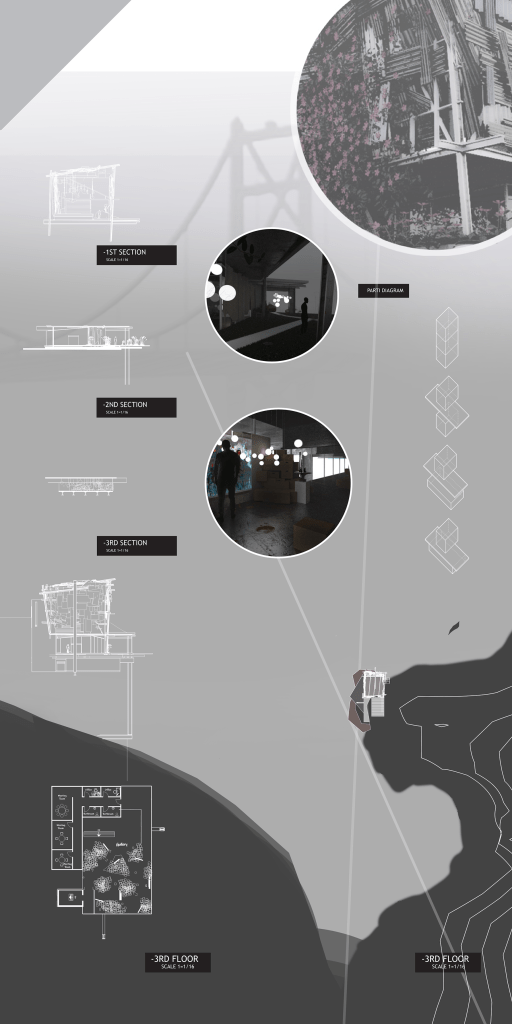
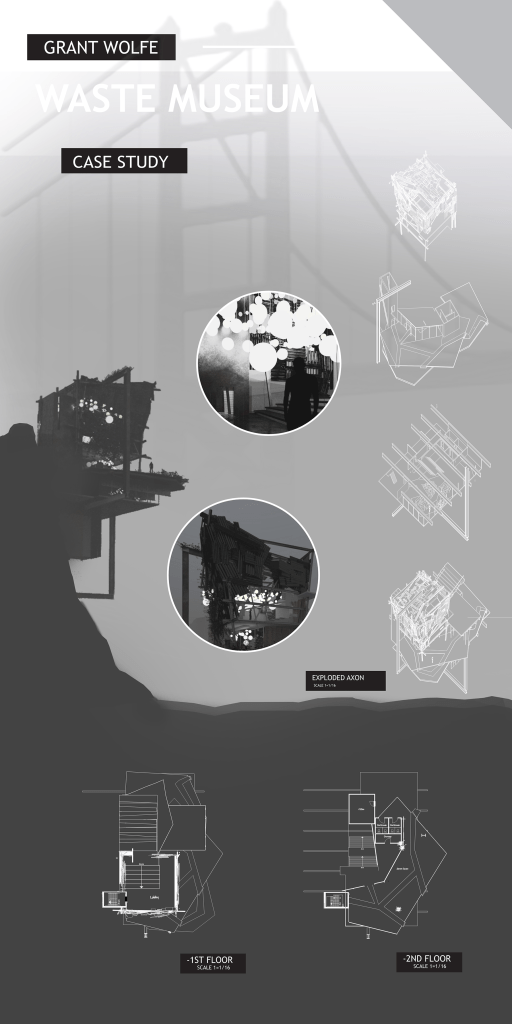
What we needed was to remember, remember the waist remember the green. So we built the waist museum to do so. Constructed entirely from the pieces left behind from early generations, it is designated into three sections. The Entrance is located to the south and is signified only by a downward-facing staircase leading to the main lobby. Built of iron beams gathered from the decrepit east bridge and incased in corrugated steel found shacks to the west, this monolith clings to the cliff as the centerpiece of this project. Glimpses to the landscape can be seen in the narrow gaps between the steel, and parts of the garden can be seen below. On the East corner lies the staircase. Built out of Large Plates gathered from the undercarriage of the bridge, this building is created only to satisfy circulation needs. It travels down to -1st and -2nd floors.
On The -1st floor lies the industrial garden. Laden with grass and flowers, the bright purples of the myrtle extenuate the devolution of the rusty iron it climbs. The pathway leads you throughout the park, highlighting the vertical views to the river basin below. The ever-looming lobby sits just above the visitor as the wind travels throughout the garden on the cliff. Nestled along the inner edge of the -1st story is a glass-encased foyer. Burlap sacks found and sewn adorn the broken glass of the hall and create the textured shadows that one can find when traveling into the -2nd floor of the gallery. Quickly upon entering the gallery level, the visitor is struck by the sense of tightness, whereas the roof and the lobby expand almost incredulously into space. The basement contracts into a seven-foot ceiling crossed with I beams. The structure’s weight is entirely above, and you can feel it crashing down. The gallery is littered with boxes from top to floor. Hidden amongst the clutter is the art. Paintings, sculptures, and murals, the morality of the art is only heightened by the waste it sits next to.
This is where you find us now, poised on the edge of a cliff; the “Waste Museum” is an homage to this new way of life and a reminder of the continual waste and damage we can produce if we ever choose to go back.
Home of Reflection
By: Hannah Gould
Site Narrative: Long ago, these modern-day grasslands were full of water and life, prompting a nomadic group to settle within the landscape. While on this site, the nomadic group created 4 large monolithic structures that are tied to the landscape and sensory characteristics. While some of their true purposes can only be guessed out, there are several predictions regarding each structure. We first have a square water collector that is presumed to have held water when rain and snow were more plentiful. Second, we have a large bridge that crosses a river in order to circumnavigate the long journey of going around the river. Third, we have a porous wall with holes that extend into different directions of the site depending on where you are located on the wall. This is believed to have played a part into viewing predators from a safe distance. And finally, we have a small collection of metal plants that create sound by colliding with one another in the wind. This is believed to have provide a safe space for people to meditate, all the while scaring off any animals that could prove harmful. Each of these structures has become integrated into the landscape and many people flock to the site in order to explore and experience each of these structures, many of whom are artists. In present times, the site is devoid of large plant life, primarily including grasses and flowers. The overreaching theme of all these objects is played into this interconnecting feature of the “journey” we all go through. The buildings established on the site and the connection between them reflect this journey.
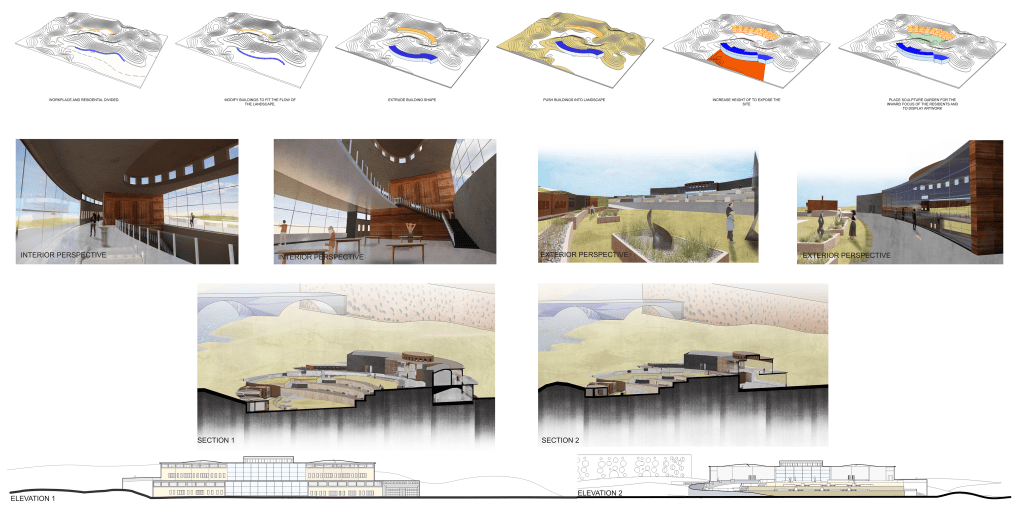
Project Narrative: My building’s is used as an artists retreat where artists live and interact with the site in order to create abstract interpretations through their artistic mediums. A journey is taken by each artist across the site to explore the area much as the nomads did many years ago. By exploring the site and encountering these monolithic structures, each artist is experiencing and is influenced by these structures in their connection to the past and the sensory characteristics they each hold. The artists then have a space to allow their creative urges to take hold of them in the form of their preferred artistic methods, such as through sculpture, painting, metal work, drawing, etc. I decided on orientating my building towards the south in order to receive the winter sun which will help heat the space during the cold months. Visitors are also welcomed to explore the site as well as the artwork created by the residents.
Within the residential spaces, in order to encourage the idea of looking away from the site and inward towards one’s self and one’s experiences, I have placed a reflection chamber in the back of each home that serves as a meditative space that remains separate from the day-to-day activities that typically take place in a home. This idea of exposure and reflection is reiterated not only in the placement and orientation of the buildings in relation to the site, but also in the programing of the rooms and progression throughout the site as well as each building.
Program Narrative: I decided early on to separate the residential building from the main building in order to create a break between living and work. This was further developed after learning I wanted certain characteristics to be found within the workplace that wouldn’t be present in the living space. For example, I wanted to force the occupants to look out towards the landscape and its potential. In contrast, I wanted the residential space to be focused away from the landscape and its structures in order to provide a place of reflection and looking inward. Because of the obvious lack of shade on the site, I decided to place my buildings in a hilly region in order to make use of the earths thermal properties. This proved ideal for the separation and levels of exposure that played into each building. The main building has a view of the Nomadic structures while the residential building is tucked into the hill, closed off to a view of the site. Inside the main building, the hallways are orientated out towards the site while the workshops are further back into the hill, allowing for a more controlled lighting within each workspace. There are two stories to the main building in order to reflect the size of the monolithic structures, making it seem like this building is a new instalment to the landscape.
In between the residential space and the main building, we have a sculpture garden that descends down the hill and links the two together. Within this garden, art pieces are put on display for the public to enjoy, much like the site and the monoliths on a micro scale. This progression from a work space through the garden to the residential space further emphasizes the idea of journey and the progression or achievements a person makes through that journey.

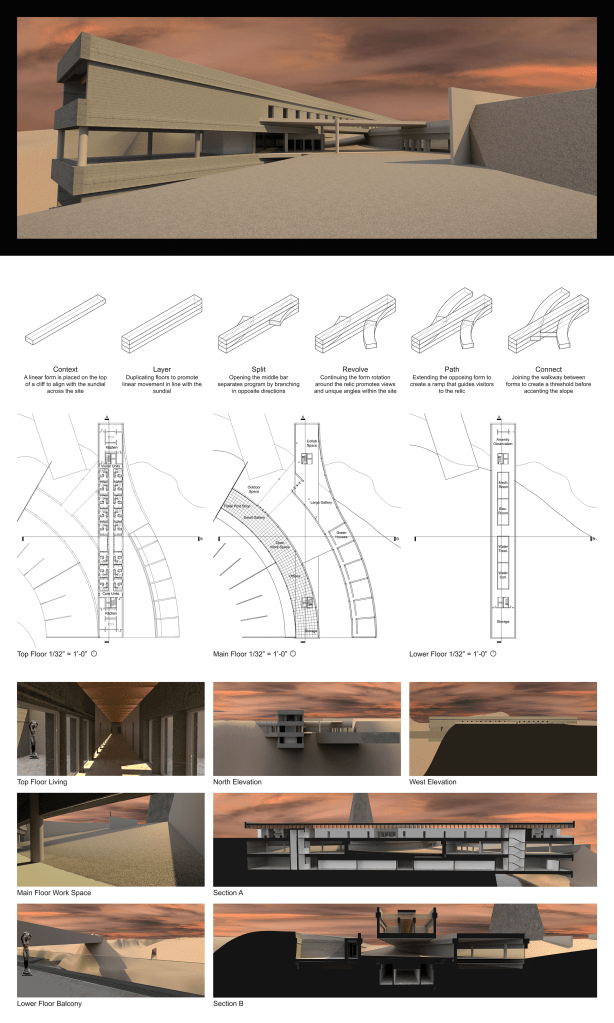
Relic Preservation & Observation Outpost
By: Oz Eckhorn
Site Narrative
The site vegetation consists of a sub desert landscape with a central water reservoir surrounded by wetland, evergreen shrubs, and deciduous shrubs. It provides water for mountain lions, wolves, beavers, lizards, snakes, and turtles. Trails cut through valleys created by steep hills that funnel wind traveling east to west. We identified six zones in our site that each represents landforms and has unique plants and animals. These zones were selected based on which plants and animals would exist in each area. Zone 1 is on the bottom. It has sand dunes and stretches in the clockwise direction. Inside this zone are plains, rock formations, valleys, hills, and canyons to the right. The area in which zones overlap creates different transitions between landforms. These transitions will become a unique condition to their location on the site. The site narrative revolves around a sundial relic. The sundial indicates when a ritual will take place and this aids in how to navigate the landscape. A dam was built over the walkway to limit water flow from the reservoir. It also conveniently happens to provide a path for people to reach the relic. Increasing water levels caused the dam to flood, so a new bridge had to be placed at a higher elevation. This bridge is key to ensuring that there is clear visibility and access to the relic. Once a year, the sun is in an optimal position, located directly above the sundial relic. The relic sculpture reflects the light and produces a beautiful sight.
Program Narrative
The outpost consists of three layers of programming. These three layers interact with the movements and relationships between the black forms. A branching bar condition places the vertical circulation at either end of the structure where all the levels overlap. The entry to the building begins at the end of the bridge and is used for circulation to the relic. An entrance to the left is a public-based program with collaboration and gallery rooms. Here, there is also a great view of the sundial at the top of the cliff. The right doorway goes to a separate workspace, but it is accessible only to the 16 inhabitants. This workspace focuses only on the relic by revolving the form of the building around the center axis of the nearby form. Between these separate entrances is a continuation of the bridge path. This is consistent with the overall architectural design, as it revolves around the center of the relic. Above the main spaces are the private living and eating areas for the core and visiting members. A bar condition maximizes the circulation and places a communal kitchen at either end of the plan. This allows for the best views and connections between floors for utilities below. On the lower floor, you will find the water collection and treatment center, mechanical rooms, and the electrical space that stores power from the solar panels which are located on the roof. The greenhouse is pushed to the back of the cliff. This makes sure that the greenhouse does not interrupt the views. It also ensures that the greenhouse is able to receive unobstructed solar gain.
Project Narrative
This building gives remote access to a historic relic and sundial. By conforming to the site conditions, and guiding circulation across the main bridge these artifacts are accessible. The structure is specifically and strategically placed at the top of a cliff. This puts it on the axis of the forms and creates a much more dramatic effect for people who approach the building from the bridge. The experience is intended to make a visitor feel as if they were experiencing something that was not from this world. The heavy concrete structure was used in the building, maintaining similarity with the weight of the black forms on the site. Precast concrete beams support the 3 floors of the bar condition. They are curved, cast-in-place forms. These precast concrete beams were specifically designed to shape each side of the path to the relic. The idea of a foundation wall on a grade beam is used to show how the structure of the building emerges from the side of the cliff. With this, it is as if the viewer was seeing what is underneath the ground on the opposite side of the building. Revealing the mass structural elements are a key component of what makes seeing this site such a special and rare experience.

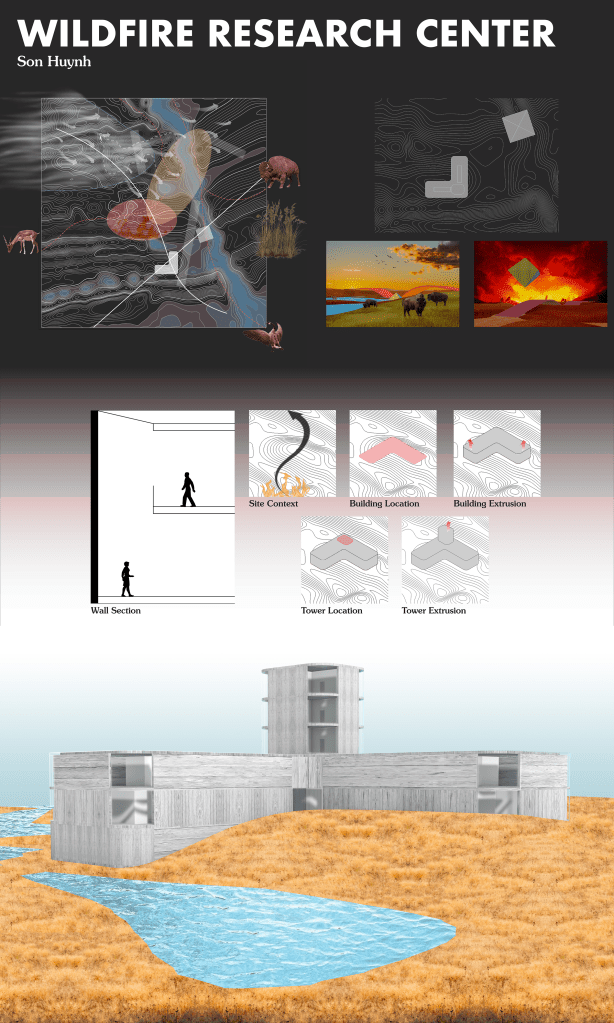
WILDFIRE RESEARCH CENTER
By: Son Huynh
SITE NARRATIVE
A prairie is bisected by a river that flows southeast. The steppe region to the east is a lush area where people can live and grow crops. Farm animals and wild animals coexist here. The west is more uninhabited, with the exception of a few wild animals such as antelopes and bison. This region is made up of wild and desolate hills and valleys with bushes growing over sand and stone. Every day, antelopes and bison cross this area to drink from the river. From the earth, a mound of jagged rocks rises. In this area, the wind is fiercest and blows southerly. Right in the middle of the map, along the river’s deepest point, lies a magnificent oasis. Flowers, tall grass, and even a few trees can be found here. It is where honeybees, antelope, bison, and humans congregate to see the most beautiful hues within hundreds of miles. Nature has devastated and threatened this oasis. This terrain has been destroyed by wildfires over the years. During the hottest period of summer, the area frequently catches fire, causing more land to burn and dead trees to spread. The river splits into several minor tributaries towards the southeast, generating small and large lakes in the grassland to the west. A pyramid-shaped object rose from the earth in the middle of the river. When fire threatens the steppe, though, this pyramid block can rise up from the earth. It revealed its actual form as a block of diamond as it flew to the highest point of the terrain, where it is most visible.
PROJECT NARRATIVE
A research center was constructed in response to the effects of wildfires with the goal of better understanding, researching, and predicting the trajectory and cycle of the fires. This center also serves as a testing ground for heat-resistant materials that can withstand a wildfire. For research purposes, the center was established along the fire’s path; because you need to get near to the source of the problem to get the most accurate result from any usability test. Despite the fact that this facility was built along the fire route, there are still large and small lakes surrounding it that aid to protect the building from the fire’s destruction. It is impossible to leave this research center alone when a fire breaks out. Those present, however, can evacuate to a higher elevation to escape the fire’s effects. A wildfire can reach 60 feet in height, according to study. As a result, the building’s height of 72 feet is reasonable. The structure is in the shape of an L, with three primary floors dedicated to study and experimentation, as well as living. The final three stories are in the inner tower, which is utilized for evacuation and as a safe haven for researchers in the event of a fire. Because the building is curved on all of the edges, glasses are installed on those edges. As a result, individuals inside the building can get a view of the fire’s origins as well as the diamond by the river. The main material used in the construction of this research center is concrete, which is known for its high heat resistance.
PROGRAM NARRATIVE
The research center is divided into six levels, the bottom three of which are used for both research and living. The upper three levels will act as a safe haven in the event of a fire. The first level, or ground floor, is dedicated to service. It is the location of technical staff’ workstations. Mechanical, electrical, and water treatment are all included on this floor. Two water reservoirs are constructed at the same time to provide water for both the building and firefighting needs. When a fire breaks out in the building, water from the water tank is pumped into the tiny water pond that surrounds the first-floor tower to keep the fire from spreading to the upper levels. The research floor, which includes laboratories and large work areas, is located on the second floor. Because they are experimenting with fire, a medic should be present to treat injured patients in the case of an emergency. There’s also an archive for keeping track of previous studies. There are also breakout rooms where exclusive collaboration areas could be created. On the third story, there are residential quarters as well as two open dining rooms and kitchens. This is the main building’s final floor. The tower’s first three floors, which are connected to the main structure, are utilized for circulation. It’s where one will find the elevator and the staircases. The fourth story is the safe haven’s first floor, with two observation rooms that provide a clear view over the fire area and the sunken diamond. Two laboratories are located on the fifth level, allowing scientists to store their important work while the fire approaches. The sixth story, meanwhile, has two bedrooms with several beds to allow those trapped inside to relax while waiting for the fire to die out.

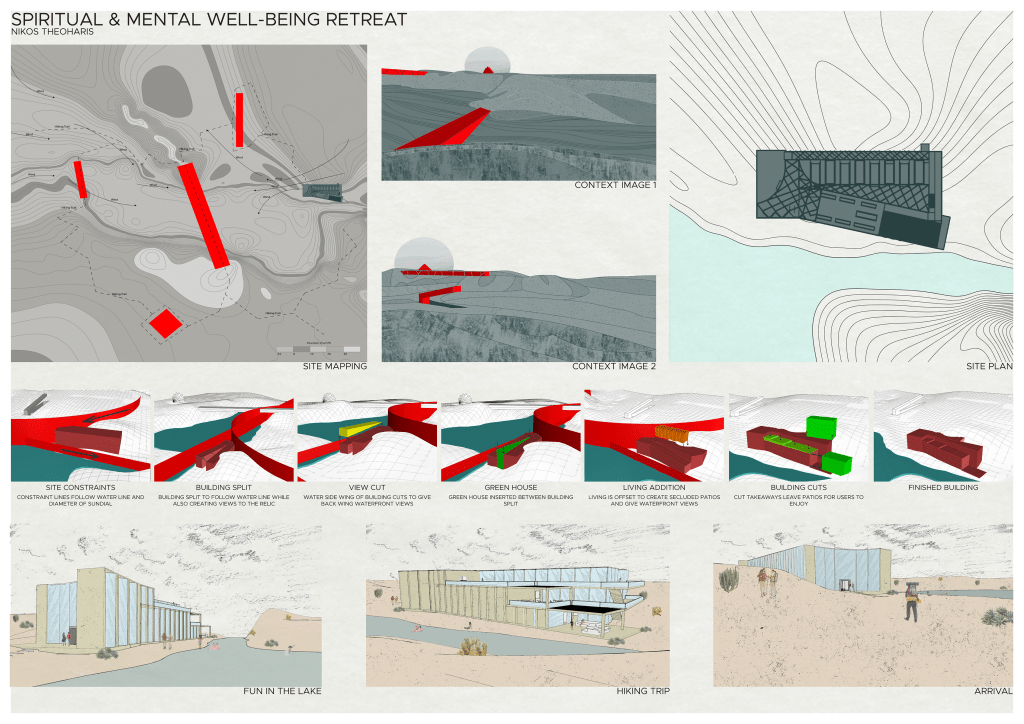
SPIRITUAL & MENTAL WELL-BEING RETREAT
By: Nicholas Theoharis
Site Narrative
The narrative of our site revolves around the yearly ritual of a historical relic and the process of navigating through the site based on a sundial located on the opposite side of the terrain. A dam was built over the walkway to limit the water movement from the reservoir and provide a path for people to reach the relic. Water levels increased and flooded the dam, so a new bridge was built at a higher elevation to ensure the people could get across while having a complete vision of the relic from the other side. People travel to the relic for ritual purposes when the sundial has a complete shadow on the sides of the negative space in the hill. The relic sculpture reflects light from the optimal sun position that occurs once a year when the sun is directly overhead. We identified six zones in our site to represent landforms that have unique plants and animals that would exist in each area. Zone 1 is on the bottom with sand dunes and continues clockwise with plains, rock formations, valleys, hills, and canyons to the right. The overlap in each zone provides an opportunity to work with transitions between landforms that will become unique to their location on the site.
Program Narrative
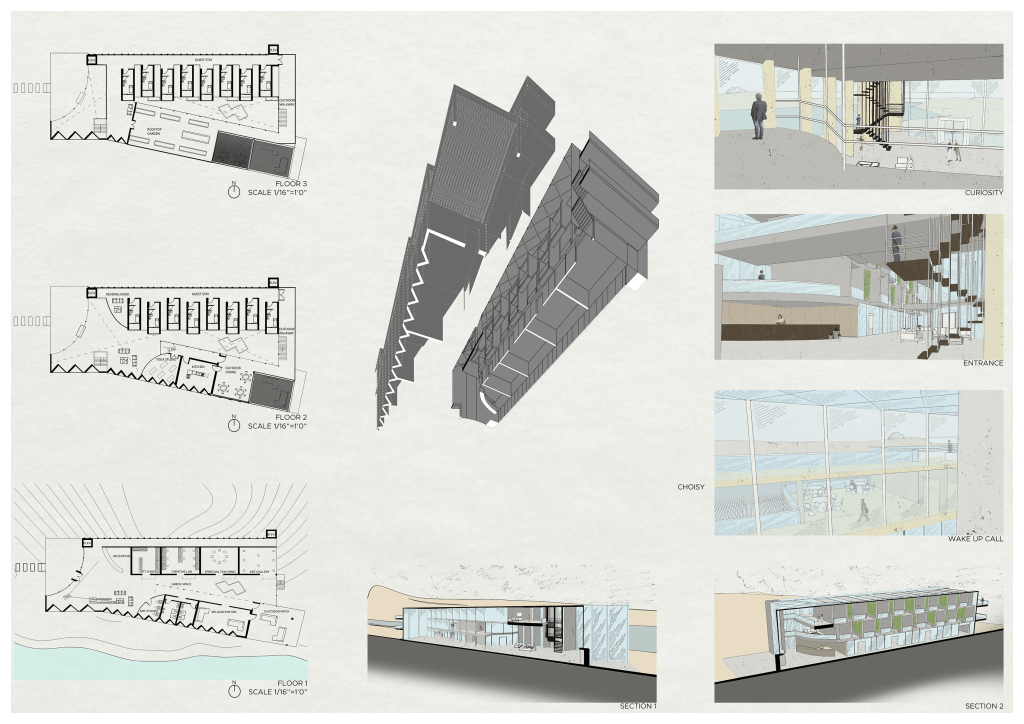
The placement of the building is set in diameter of the site’s sundial and along the river. The purpose of this location is to ensure the guest gets views of both the sundial and the relic. I cut the third floor off the south side of the building to allow the north side 3rd floor to have a clear view of the relic and the water and replaced it with a rooftop garden. I then split the building to create a space for a green house and add a fanning effect to the building like the relic. After, I chose to takeaway or combine programs such as reception and administration or the extra kitchen. When considering putting the living in I chose to place it on the second and third floor where both sets of these rooms will have views to the relic, I did this so that it creates an urge in the guest to go explore and visit these objects. The reason I didn’t place the building closer to the relic was that the journey to travel there is what makes this location important. With all this in mind I wanted to add more outdoor space for people to explore and clear their mind from their struggles, so I added a patio on the first and second floor. The first-floor patio would be used mainly for relaxing and talking to other guests, while the second-floor patio would be used for dining and collaboration as well. This patio sat next to the public kitchen where the guests are encouraged to cook for themselves. I wanted to make it a public kitchen because I find cooking a good way to get your mind off problems you’re struggling with and in the end make you feel good about yourself.
Project Narrative
The whole purpose of my building is to help people with mental and spiritual health. So, therefore I created that distance between the two because no matter how far away you are you can still get to your goal. With this building I wanted to ensure people felt like they were in a positive space, So I researched some of the best ways to feel better. The first one I found was to have plenty of sunlight because sunlight increases your serotonin which helps you feel better. Learning this I wanted to create an atrium that left you in awe and made you want to heal your illness/problems. I also incorporated plenty of sunlight this adding glass to the roof and the south-facing façade. For the south façade I angled the glass to point directly at the relic, to give people the reminder what they are searching for… their true self. Another thing I found intriguing was concrete and its way of making you feel safe. I incorporated this into each of the guest rooms so each person can have their own safe space whilst still having views of the open greenhouse below as well as the relic in the distance. I also incorporated a walkway that goes around the whole building both interior and exterior, I added this because one of the best things you can do when struggling with mental illness is to walk and clear your mind and enjoy the environment surrounding you. I think my building beautifully captures the environment by giving multiple opportunities to look to the exterior site around it.
untitled
By: Sofia Gawrick
Site Narrative
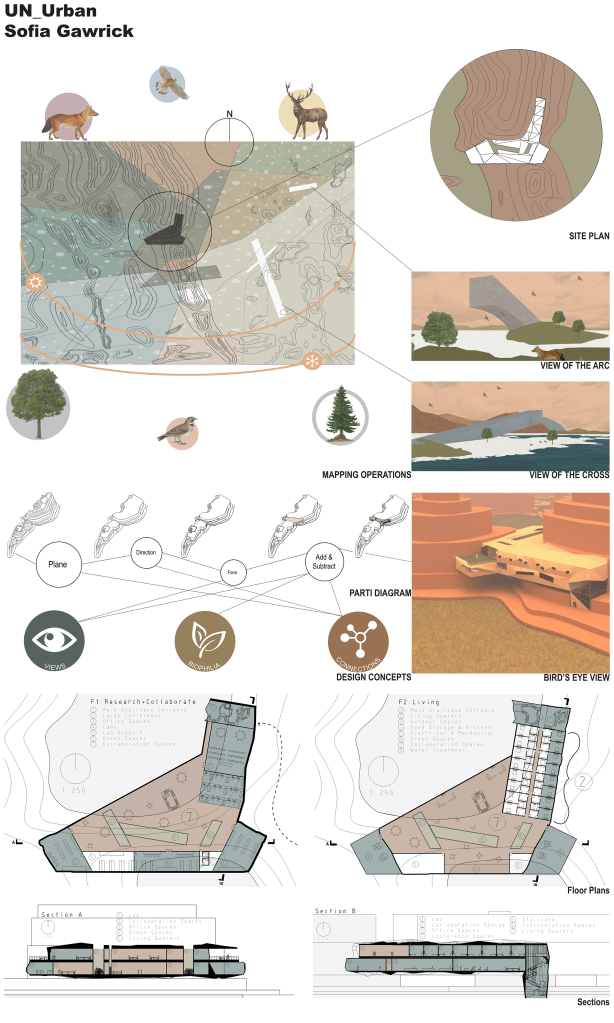
There is a landscape with two distinct biomes, being a mountain range and grassland. The western part is full of rocky terrain and soaring views. Never a dull moment in its elevation, with peaks and lows along every curve. To balance this rocky terrain is the smoother grasslands to the east. Smooth and nourished with lakes, the land much more fertile and understanding- full of soft grass swaying. Inhabited once by humans, the only thing left of their legacy is their ruins. These ruins can only tell part of the story but seemed to have brought them together as a community. High in elevation in the mountain range, sits a monument dedicated to rituals. The temple, although not able to tell its full story, was believed to have been used for dedication and commemoration to their beliefs. Aligned in orientation, lays a ceremonial commemoration just west of the temple. This piece was believed to have been used for ceremonies like a wedding or formal events. Unlike its other two siblings, the third is a monolith facing the west, towards the mountain range. The monolith is less clear in understanding its purpose but possibly intended as a watchpoint that was used to scout enemies during war and herding livestock during peacetime. Seemed to have been derived from the stone from the mountains, these pieces all have similar characteristics. Seeming to have very basic geometry makeup, they all consist of two: rectangles and arches, though each geometry is implemented in different parts of the pieces.
Project Narrative
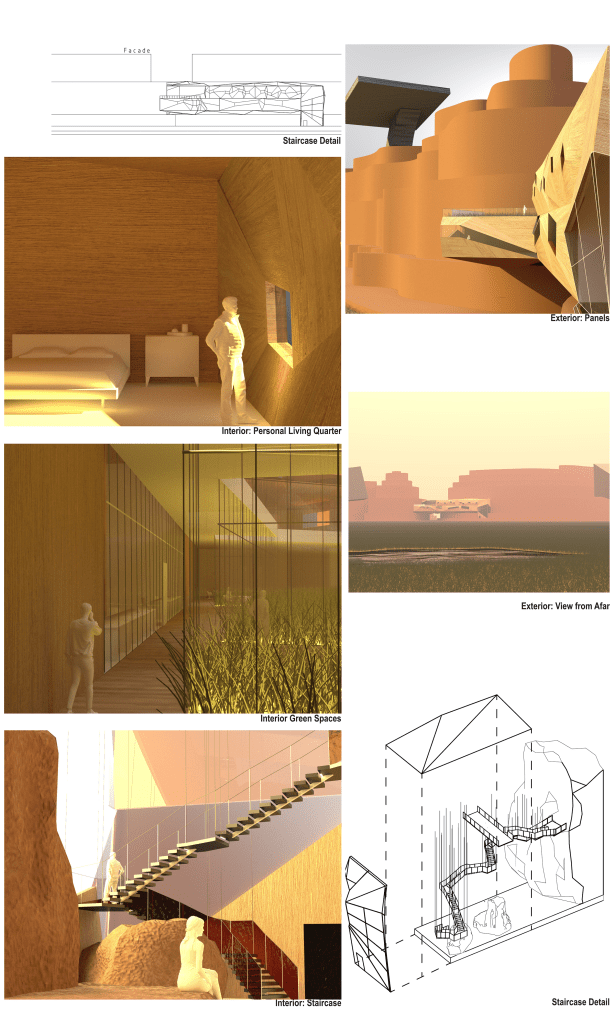
As research was conducted upon the relics, it was found that they belong to a time period that we didn’t know existed and was missing in humanity’s timeline. Considering this could have crucial evidence to explain humanity’s past further, a research facility has been placed. The building allows for research and living spaces for the scientists in the remote area. It is also meant to help researchers go from one relic to another, as one is at the of a mountain and the other two down below in the grassland area- tying the three relics together vertically in elevation. This also helps decrease the impact the building has on the landscape to try and preserve it (the surface where they mainly would’ve only been able to touch). The overall form was first made using the curvature of the two mountains that was also intertwined in between the two peaks. This allows for views of both the west, with its vast mountain range, and the east, with the two relics standing strong amongst the soft grazes of grass. Then, to open the building up, voids were added. Once again to make the rooms with views more accessible and allow for biophilic aspects to be implemented into the interior of the building. Tying connections that these mountains were carved by said humans, the exterior of the building mimics the man-made landscape. The exterior is meant to mimic the mountains that was there before, but instead, use geometries to create a “human-made” mountain texture for the building. These panels also line up with the interior program, to give each room an interesting view. The panels will also be prefabricated to help mitigate the impact the building will be on the landscape. Another room that plays off the “human-made” but mimicking the original site, is the main entrance/ staircase. This room is meant that as you approach the building, you are lured into it. And as you look inside, be able to see this twisty and steep stairwell- meant to metaphorically mimic the climb you would’ve had to make if the mountain had never been enacted.
Program Narrative
The overall program is based on the idea of Research + Collaborate on the first floor and Living on the second floor. For the first floor, the work aspect of the building (Research + Collaborate) is located here. Research are rooms such as the labs, lab supports, and storage rooms that are needed for the main purpose of this building- to understand the humans that were here before through the artifacts and land. To help them better communicate amongst one another, informal collaborations spaces, as well as a large conference room, are implemented. To separate between work and life, the second floor breaks away from the first floor and focuses on the Living aspect. This is where the visitors and residents living quarters, food storage/kitchen, outdoor spaces, and collaboration spaces are located. This allows for relaxation and separation from their work and allow for them to have spaces to connect with one another. And to further enhance the experiences of both level’s programs, three design concepts were added: Views, Biophilia, and Connections. Views are spaces that allow for views outwards, to the west and east. The west shows showing the expansive mountain range, while views of the east look down upon the relics and calming grasslands. Biophilia spaces are essentially green spaces that penetrate the core of the building, allowing for nature to be integrated in the spaces furthest away from the outside. As shown through research, biophilia also increases productivity as well as concentration. This also gives them a chance to grow plants for eating in a much more controlled environment, than it may be to try and grow food anywhere in the area. The spaces between the Biophilic and View rooms are the Connection spaces. These spaces are meant to further make these rooms more accessible, as well as make room for people to connect and collaborate in these spaces.
Lab
By: Allison Woodring
Site Narrative
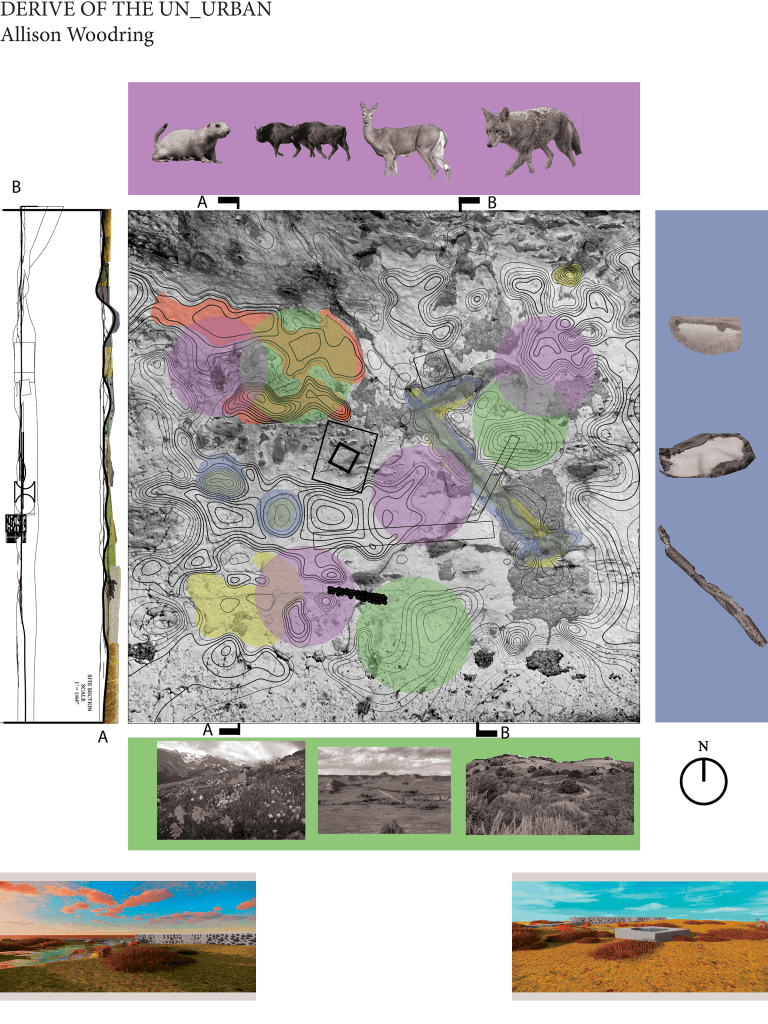
Once long ago a group of nomadic people stumbled upon a grassland area lush for settling for a while. In their time there, the group constructed 4 monuments in the grasslands. Each one would protect a certain aspect of their life and benefit the people to come. These were protections of sight, peace, water, and life. The protection of sight works in ways that depending on where you are coming or going from, you see a different perspective of the land. The vibrations of the metallic thin structures in the wind protects the peace, enabling a sanctuary for the people and keeping animals away. There was also once a drought in their time there, and seeing that, the people constructed a collection tank for the water to have and use when needed. The bridge crossing the river is a transparent bridge, enabling those who cross to see the water below and respect that the water could pull someone or something under when currents are high. This bridge functions for both the people who once resided here, and the animals making their way to the stream. The land while seemingly touched, still remains untouched for those who wish to use and respect the nature around them in the future.
Program Narrative
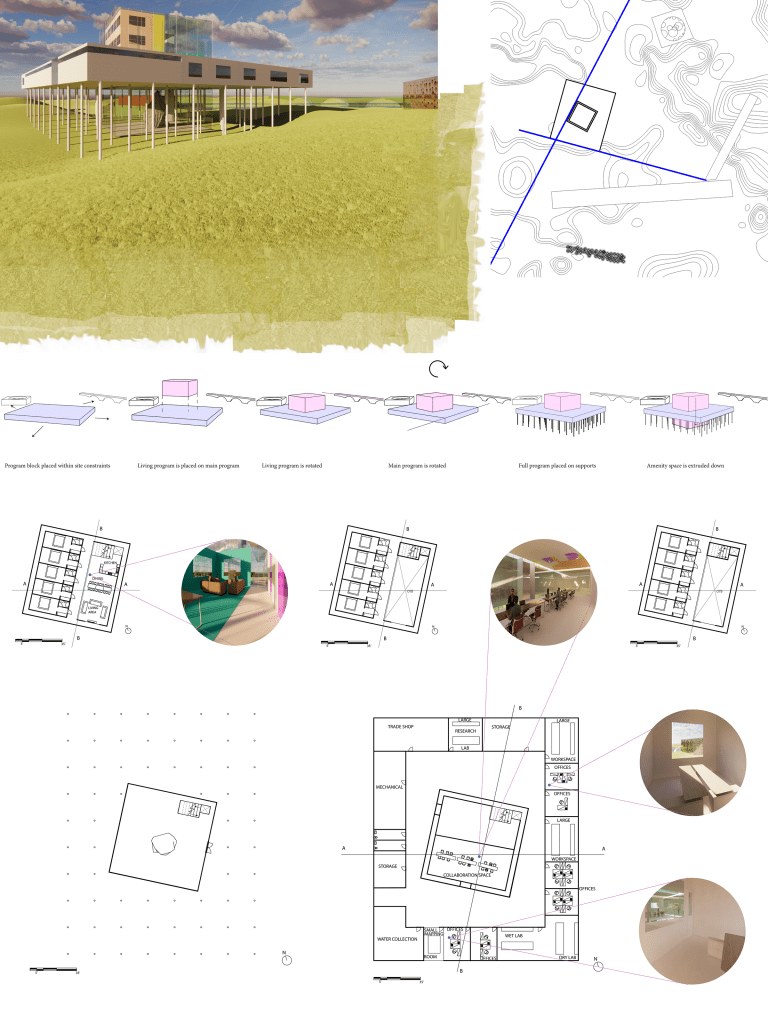
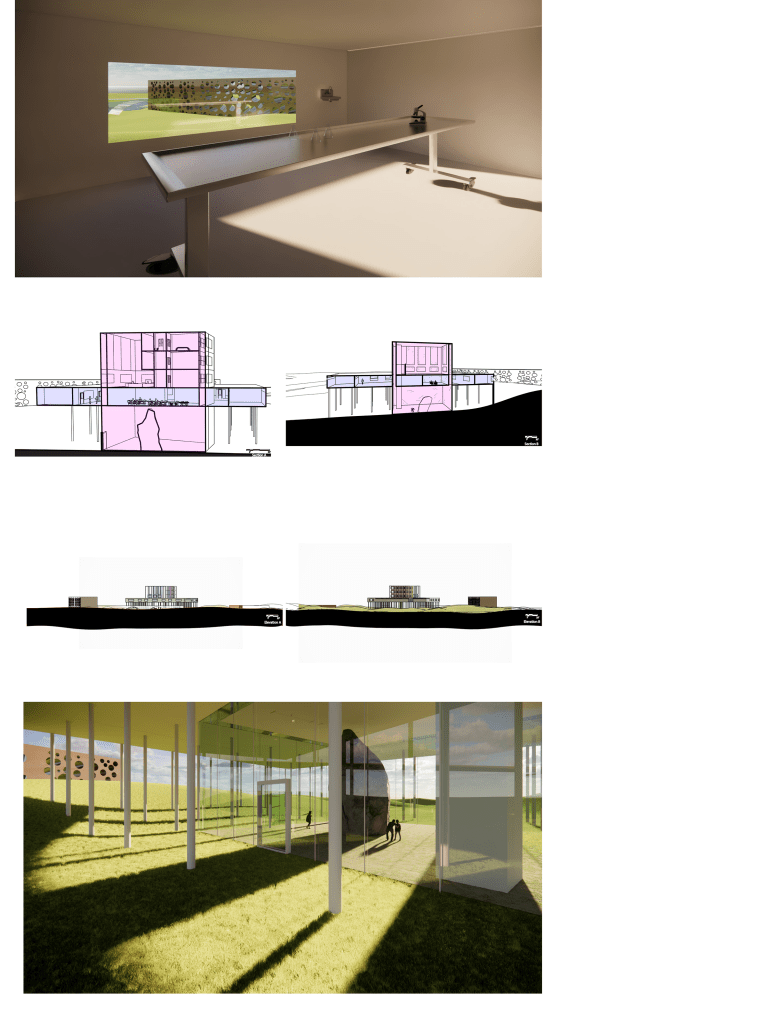
The building program is environmental archaeology, which focuses on why and how societies of the past functioned. Wikipedia describes it as “the science of reconstructing the relationships between past societies and the environments they lived in.” Environmental archaeologists, archaeobotanists, zooarchaeologists, and geoarchaeologists, with the latter three being sub categories of environmental archaeology. It is on the site to study the interventions left by a nomadic group many years ago and to figure out how those who used the site lived and used the surrounding area. State of the art labs and a thirst for knowledge is reflected in this building. Great minds from all over will come and collaborate to uncover the mystery the land holds. The views and location of the outpost is central to all 4 interventions, enabling the occupants to use and study the site.
Project Narrative
My project highlights a distinct separation of the vertical and horizontal spaces, living and lab spaces respectively. The concrete of the horizontal program is a stark contrast from the glass façade of the vertical program. The layout of the lab promotes collaboration and sharing ideas with an open viewing collaboration space centrally located and easily visible. Each lab and office provide views out onto the site, enabling those working to see the objects they are studying. The organization enables every room to be a space of knowledge. This also allows the combination of present and past, as table top experiments of old can be performed while taking that step into the modern world. The meshing of concrete and glass also reflects this point as it is taking the heavy/old material with the light and more modern approach of glass.
 studio ambiguous